A customer taps "Book now" on their phone, fills in a few details, pays, and has a confirmation in their inbox within seconds. From the outside, that's the whole story.
Except that in those few seconds, a good booking system has quietly answered a dozen questions that used to be somebody's job. Was that slot actually free? Has someone else grabbed it in the last thirty seconds? What should it cost today, for this customer, with those extras? Who on your team needs to know? And what happens if the payment fails halfway through?
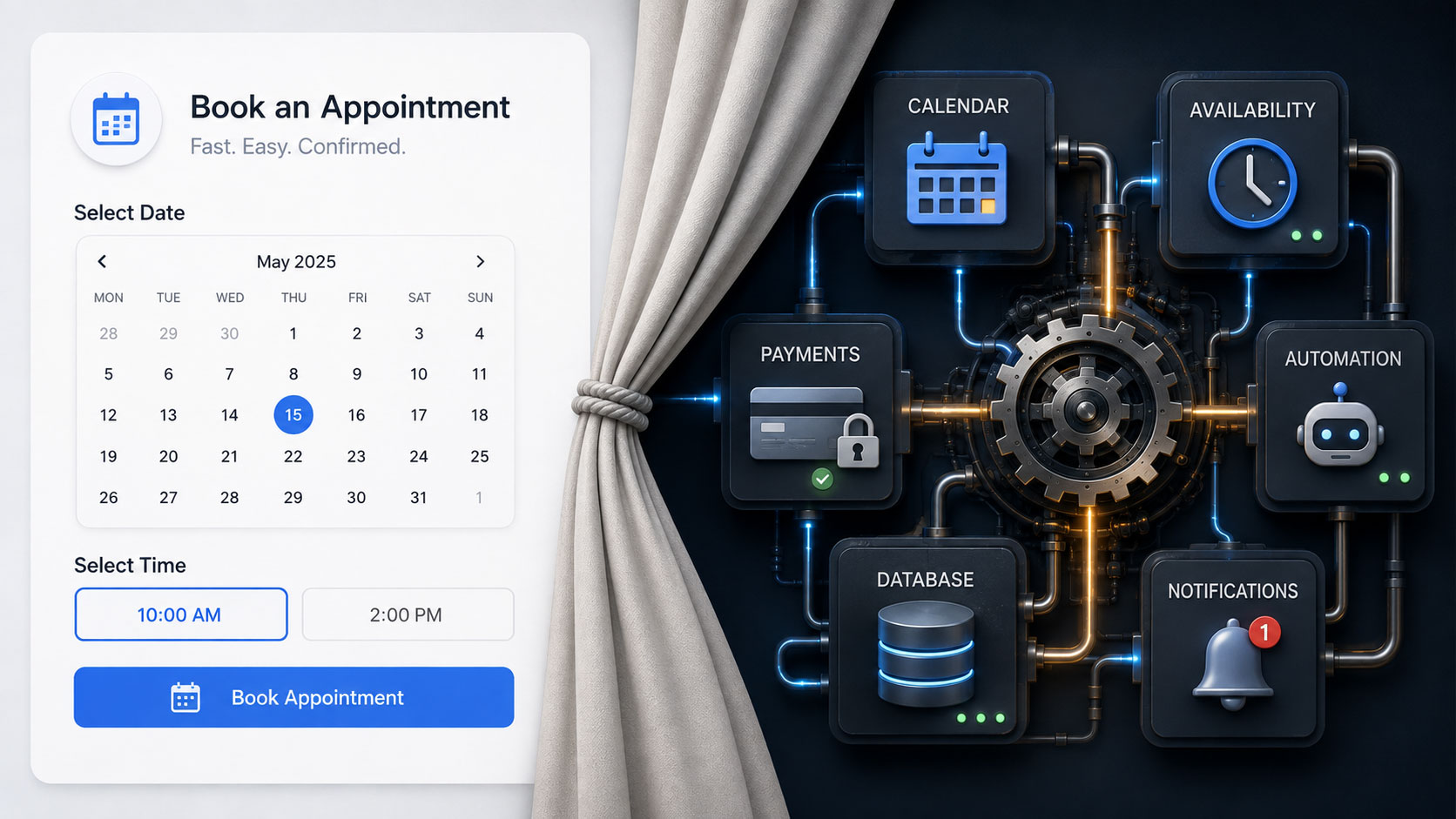
If you're thinking about a booking system for your business, or wrestling with one that keeps letting you down, it's worth understanding what's really going on behind that button. The difference between a booking system that works and one that creates work is almost entirely in the parts you never see.
Availability sounds simple until you write down what's actually being reserved. It might be an appointment in one person's diary. It might be a room for several nights, seats on a departure, a piece of equipment for the weekend, or some combination of all of them.
Take a coach holiday, something we know a bit about from our work with Jones International. One booking touches departure capacity, pickup points, room types, passenger ages, supplements and optional extras. Selling the last family room changes what the next customer can choose, even though there are plenty of seats left on the coach. A clinic appointment might need a qualified person and a particular room, at the same time.
Treat all of that as a single number and you get overselling. Or its equally annoying twin: turning customers away from slots that were actually fine.
A proper system models resources, times and rules separately, and it knows exactly when availability gets checked: while browsing, at the start of checkout, when payment begins, and at the moment the booking is finally confirmed. Those are four different questions, and they can have four different answers.
It's 8pm on a Sunday. Two people, on two sofas, are both looking at the last available space. Both tap the button within seconds of each other. Who gets it?
The answer should never be "both". A well-built system places a temporary hold the moment someone starts checkout. That hold expires predictably if they wander off, releasing the space back for sale. Your staff can see the difference between a genuine booking and an abandoned attempt, and the system knows what to do in the truly awkward moment when a payment succeeds just as a hold runs out.
None of this is exotic. It's simply the kind of thinking that has to happen before anyone designs a screen.
Ask anyone who's built a few of these: the calendar is rarely the hard part. Pricing is.
Prices change by date, duration, occupancy, customer type and the extras somebody picked. Discounts have eligibility rules, and some of them argue with each other. Then there are deposits, staged balances and cancellation terms, each adding another state a booking can be in.
Our view is that these rules should be written down explicitly and tested with real examples, not buried in code and discovered later. Your staff should be able to explain why a total came out the way it did. And the price recorded on a confirmed booking should never quietly change because someone edited next season's rates. A clear breakdown does one more thing, too: it makes customers commit faster, because nothing erodes confidence faster than a total that appears out of nowhere.
For every customer-facing screen, there's an internal one doing the heavy lifting. Amendments, cancellations, refunds, no-shows, the daily manifest, the room list, the reminder that didn't get answered. Every booking should have a clear state and an obvious next action, so nothing sits in limbo waiting for someone to remember it.
The same goes for communication. Confirmations, reminders and follow-ups should go out at the right moments without anyone typing them, and there should be a record of exactly what was sent and when. When a customer says "nobody told me", you want to be able to check, not guess. Much of this is exactly the sort of thing automation does brilliantly, and if you're wondering how far to take that, we've written about choosing between AI and automation.
Failed payments. Double-clicks. A dropped connection at the worst possible moment. The customer who booked the wrong date and is now on the phone, slightly frantic.
A booking system earns its keep on these days, not the sunny ones. Problems should be visible, controlled and recoverable: a failed payment shouldn't leave a ghost booking, an amendment shouldn't lose the original details, and staff should be able to fix the unusual case without a developer on speed dial.
If your service is a simple diary, a generic booking platform will probably do you fine, and we'd tell you so. But when your business has its own rules, the platform's assumptions start to chafe, and your team ends up working around the software instead of with it.
That's the point where a booking system built around your actual service pays for itself, sometimes with a mobile app on top for customers who book on the go, as we built for Jones International's passengers.
Your booking journey is often a customer's first real experience of your business. It's worth getting the invisible parts right.



We're proud to have been recognised as Wales' Most Trusted Web Design & Development Company for 2025. This award reflects our commitment to delivering exceptional digital solutions and outstanding client service that sets the standard for excellence.