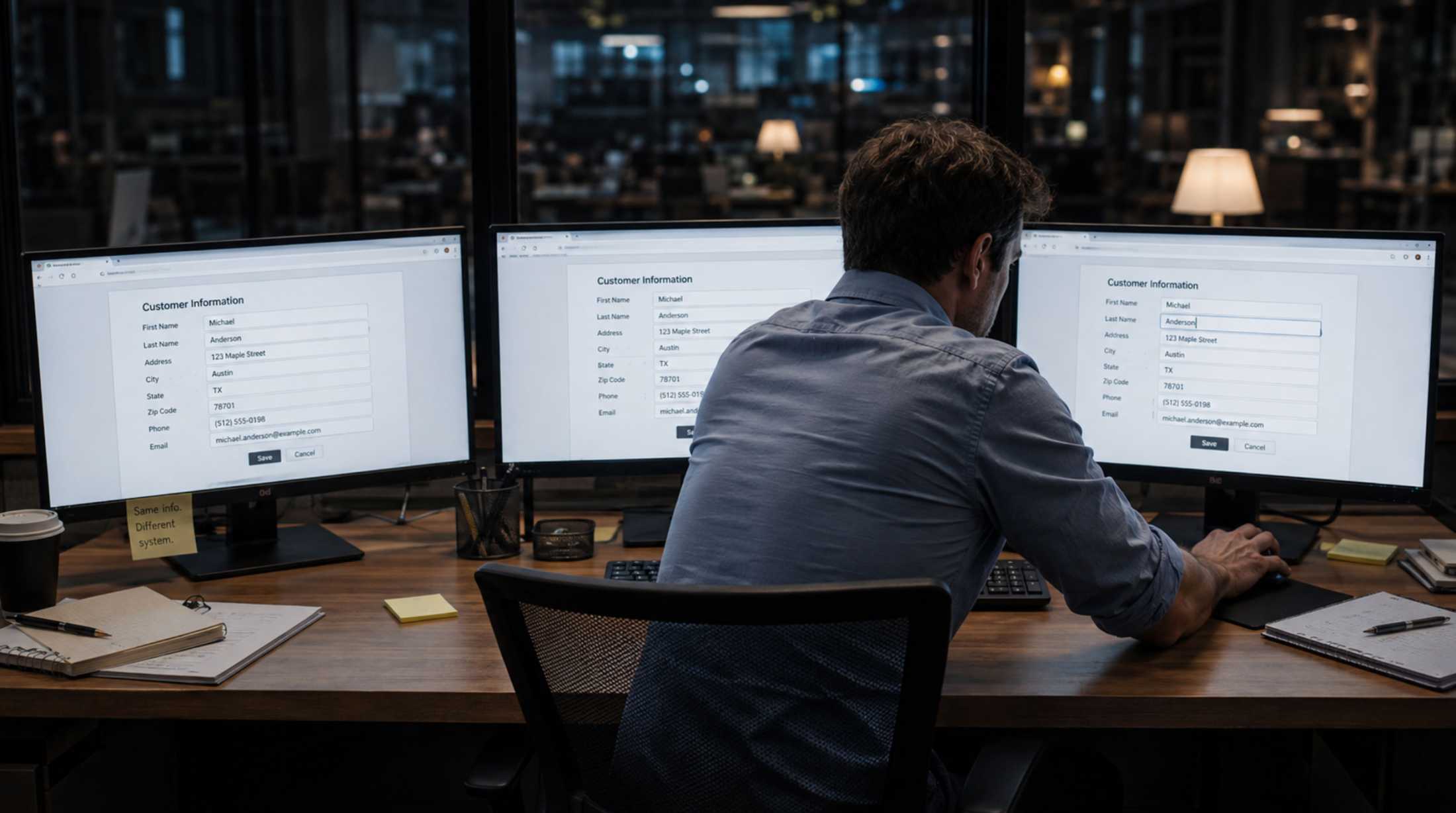
Follow one order through your business and count the keyboards it touches. It arrives by email. Someone types it into the spreadsheet. Someone else types it into the accounts package. A third person types the address onto a courier label. Four versions of the same information, each typed by a busy human, and the odds that all four agree get worse by the hour.
Each individual re-entry takes a few minutes, which is exactly why nobody adds it up. But the real cost of double-keying isn't the typing. It's the discrepancies, the delays, and the corrosive little question that follows your team around all day: which version is right?
No one designs a business this way. Tools arrive one at a time, each solving a real problem on the day it was bought. The website handles enquiries, the sales platform tracks prospects, the accounts package produces invoices. Each one is fine. What nobody designed is the flow between them, so your staff became the integration.
To be fair, manual transfer sometimes starts as a sensible control while a new process beds in. The trouble is that the temporary workaround quietly becomes permanent, and nobody ever goes back to ask whether it still earns its keep.
If you want to know what double-keying really costs you, don't ask for estimates. Sit with the person who does it and watch a normal case: the logging in, the checking, the formatting, the hunting for the missing reference, the confirming that the second system actually accepted the record. Multiply by how often it happens in a week.
Most owners who do this exercise are surprised twice. Once by the time, and again by how much of it is checking rather than typing. Checking is the tax you pay for not trusting your own data.
The typed-in-a-hurry postcode. The invoice raised against last month's price. The customer who got two confirmation emails with two different dates. Every re-entry is a chance for the copies to drift apart, and once they have, someone has to notice, investigate and repair, usually after the customer has noticed first.
Then there's the delay. Work sits between systems waiting for a human to carry it across, so the next action starts hours or days later than it needed to. Your process isn't slow. Your handovers are.
The fix is rarely a big new system. More often it's connecting the systems you already run so that a fact gets typed once, by the person closest to it, and flows everywhere else with clear ownership and proper controls. Where volumes are high, automation does the carrying; where judgement is needed, a person stays in the loop. We've written about where that line belongs.
We saw the payoff at scale with Motocross Parts UK, where a catalogue of thousands of products simply couldn't survive on retyping. The same principle applies at ten orders a week: the data should do the travelling, not your team.
One last thing, and it matters: this is never about blaming the person doing the typing. They've been holding your systems together by hand. The kindest thing you can do is take that job off them, and give them back the hours.
If you'd like to know what your version of this is costing, we'll happily help you find out. Bring us the process, and we'll follow the data through it with you.



We're proud to have been recognised as Wales' Most Trusted Web Design & Development Company for 2025. This award reflects our commitment to delivering exceptional digital solutions and outstanding client service that sets the standard for excellence.