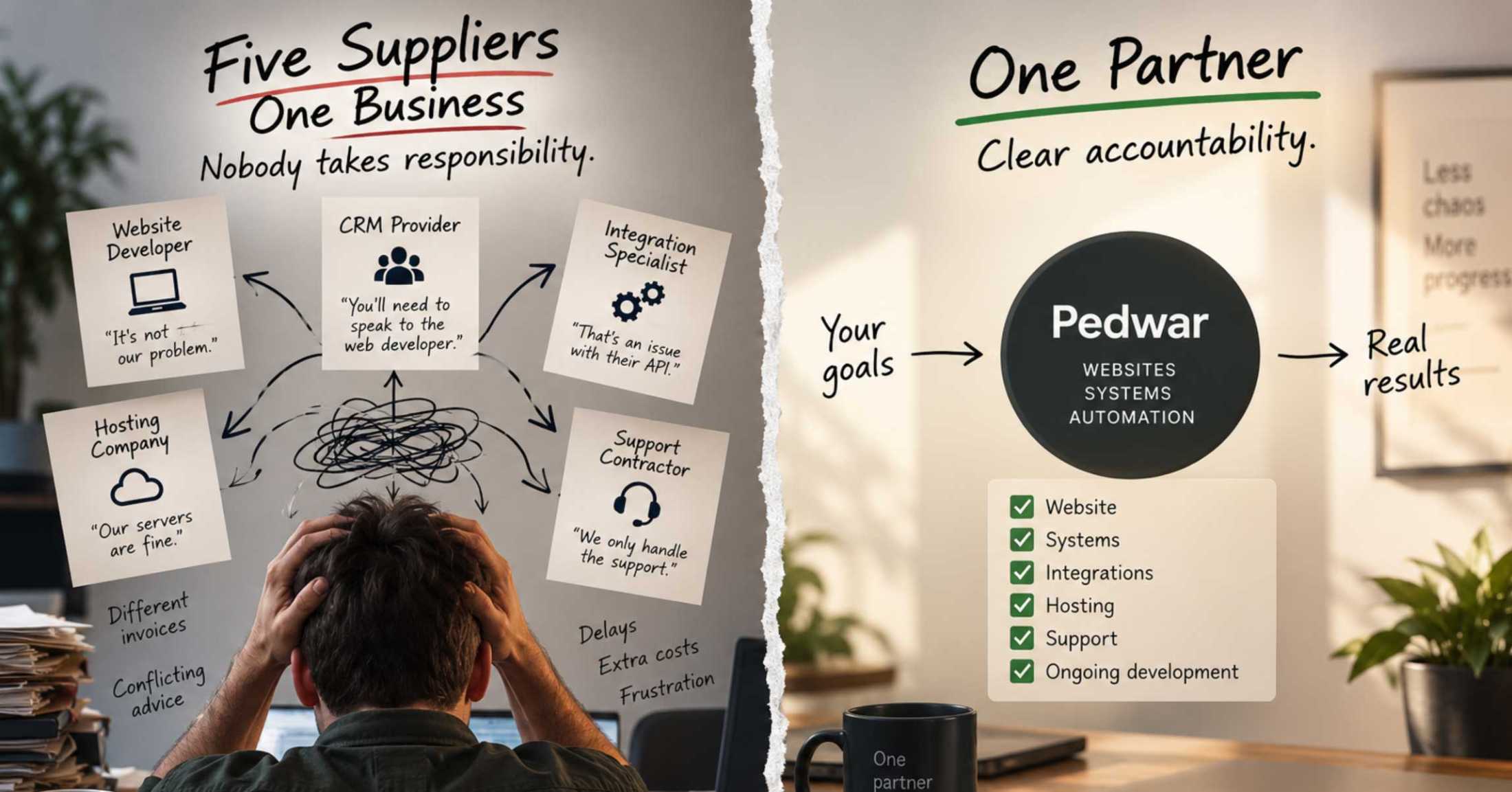
That is the quiet cost of accumulating suppliers one project at a time. Each individual decision can seem sensible enough. A website here, a booking tool there, some quoting software, an accounts package, a bit of glue in the middle. But over time you end up with a business process nobody owns from end to end, and the gaps between systems become your responsibility.
The problem is not that you have several tools. Most businesses should. The problem is having nobody accountable for how those tools work together.
That is why we think many businesses are better served by one partner across their website and systems. Not because one company should do absolutely everything, but because somebody should understand the whole journey, make the build, buy and integrate decisions coherently, and answer the phone when the joins start showing.
What usually hurts is not the subscription fee or the development invoice. It is the staff time, duplication and confusion created when systems do not properly speak to one another.
Take a simple example. A customer submits an enquiry through your website. Somebody copies it into the CRM. A quotation is created somewhere else. If the customer goes ahead, the details are re-entered into the booking or order system. Later, somebody raises the invoice in the accounts package. Every handoff is another opportunity for delay, error or inconsistency.
Individually, none of those steps may sound disastrous. Repeated dozens of times a week, they become expensive. If your team handles 40 enquiries a week and wastes just 10 unnecessary minutes on each one, that is nearly 350 hours a year. That is before you count mistakes, missed follow-ups or the general irritation of doing the same job twice.
Most businesses do not need more software at that point. They need more joined-up thinking.
The website is often treated as though it sits in a different category from the rest of the business. The nice-looking thing at the front, while the operational machinery sits elsewhere. In practice, the website is where the process begins.
It is where the enquiry starts. The booking begins. The order enters the system. It is not just a brochure. It is the front end of an operational workflow.
That matters, because the quality of the customer experience and the quality of the internal process are tied together. A lovely front door opening onto a corridor of copy-and-paste is still a poor system.
One partner across the journey designs the door and the corridor together. The customer moves from first click to final invoice through one coherent experience, and your data moves with them, entered once, used properly and owned clearly.
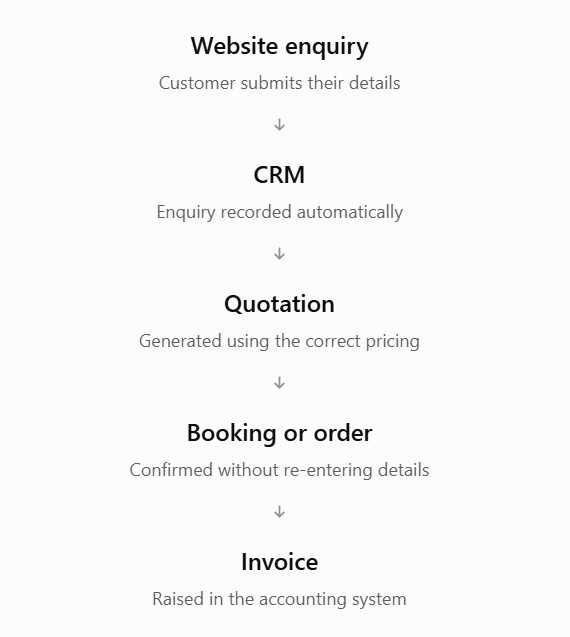
That sort of flow is not complicated for the sake of it. It is simply what happens when the website, CRM, quoting, ordering and invoicing are considered parts of the same process rather than separate little projects with separate little owners.
It is worth being clear about what we are not saying here. We are not arguing that every business should throw away specialist products and replace them with one giant bespoke system. Quite the opposite.
The right answer often still includes best-of-breed tools: the accounts package, the payment provider, the CRM, the software that already earns its keep. The value of the partner is not in pretending those products should not exist. It is in deciding sensibly what to build, what to buy and what to integrate.
That distinction matters. A company claiming it can do everything is not automatically the right choice. The real advantage is having one accountable partner who understands the whole operation and owns the connections between the parts.
Integrations are often the orphans in a multi-supplier setup. Everybody depends on them, but nobody really wants to own them. Under one partner, they finally have a parent who feeds them, monitors them and answers for them.
Almost any arrangement can look acceptable on launch day. The real test is what happens six months later when the business evolves.
Suppose you change your pricing structure. Or add a new service. Or introduce a deposit. Or need staff to capture a new piece of customer information. In a fragmented setup, that one change may affect the website, the CRM, the quoting process, the booking system and the accounts integration. Someone has to understand those dependencies, coordinate the updates and make sure they happen in the right order.
If nobody owns the whole picture, that coordination job lands on you.
That is one of the biggest advantages of a single accountable partner. The benefit is not just cleaner delivery at the beginning. It is having somebody who understands how the moving parts fit together as the business changes.
The same applies when something breaks. At 9am, nobody wants a conference of deniers. They want one phone call, one owner and one clear answer.
When the people shaping the customer experience and the people building the operational system are working as one team, each informs the other. The design reflects what the system can genuinely do, and the system is shaped by how customers actually behave.
Security benefits too. Not because one partner magically removes risk, but because security is planned across the whole journey rather than at each supplier's fence line. Attackers are notably uninterested in your org chart.
So are outages. If changes to the website, the CRM and the integrations are coordinated properly, they are less likely to trip over one another. That sounds unglamorous, which is probably why it gets neglected. It is also exactly the sort of detail that determines whether systems feel dependable in everyday use.
The obvious concern with a single-partner arrangement is dependency. Fair enough. Putting more responsibility with one company only works if the arrangement is transparent and portable.
That means you keep ownership and control where it matters: your domain, your data, your hosting accounts, your third-party logins and, where appropriate, your code. It means documentation exists. It means another competent team could take over if needed.
We would argue that this is precisely what makes a one-partner model safe. Accountability with the door unlocked.
And honesty cuts the other way too. Sometimes several partners genuinely is better. You may need a specialist with deep expertise in a niche area, or a scale we would be pretending at. A partner worth having says that unprompted.
If you are wondering whether this applies to you, these are usually the giveaways:
If two or three of those sound familiar, the issue is probably not your team's competence. It is the structure around them.
The first build is the easy part. The real question is year three. Who is improving the system? Who is watching the integrations? Who understands how the website, software and support fit together? Who answers the phone?
That is the relationship we aim to build across websites, business systems and the support behind them. It is the same joined-up thinking we bring to projects such as Jones International, where the operational side and the customer-facing side need to work as one journey, not two unrelated ones.
If your suppliers currently outnumber your systems, and the gaps are starting to show, we would be glad to be the one phone call.



We're proud to have been recognised as Wales' Most Trusted Web Design & Development Company for 2025. This award reflects our commitment to delivering exceptional digital solutions and outstanding client service that sets the standard for excellence.