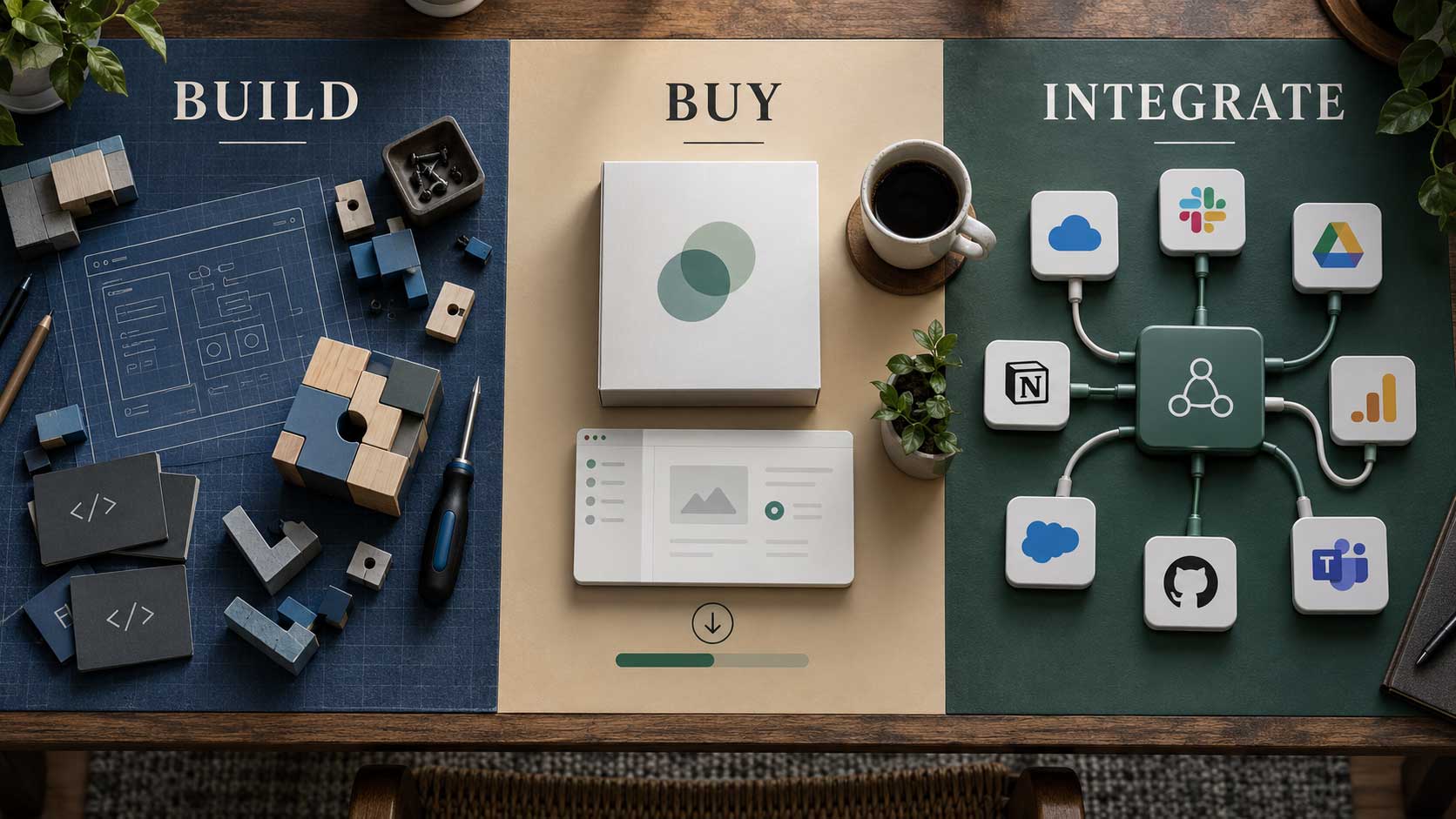
Every software decision your business will ever face comes down to three doors. Buy a product someone else built. Build something shaped exactly to you. Or the door everyone walks past: integrate the tools you already own and get most of the value for a fraction of the money.
Each door has a price you pay now and a price you pay later. And the businesses that choose well aren't necessarily the ones with the biggest budgets. They're the ones that defined the problem before comparing solutions.
So let's do it in that order.
Not "we need a CRM" but "enquiries wait two days and nobody owns the follow-up".
The first phrasing sends you shopping for software. The second tells you what any solution, bought, built or connected, actually has to achieve.
It's a small distinction, but an important one. Once you understand what's going wrong, you can make a much better decision about how to fix it.
And that brings us to your three options.
Best when what you need is common, well understood and already available.
If your business needs accounting software, email, payments or a straightforward CRM, buying an established product is usually the grown-up answer.
These products carry years of investment in reliability, security and support that no sensible bespoke budget should try to replicate. Why pay to reinvent something that already works?
The trouble starts when your business doesn't quite fit the product.
Perhaps your quoting process is unusual, or the software expects your team to work in a particular way. You make one small compromise, then another. Before long, you're maintaining spreadsheets and inventing workarounds just to get through the day.
Eventually, the subscription becomes the cheapest part of owning it.
The question to ask: Can we use this software without changing the things that make our business work?
Best when the way your business works is part of what makes it successful.
Some processes are too important, too unusual or too specific to squeeze into somebody else's product.
Maybe it's how you calculate prices, organise schedules, manage bookings or handle complex customer requirements. If doing those things differently is part of why customers choose you, forcing them into a ready-made system could mean sacrificing the very thing that sets you apart.
That's where bespoke software stops being an indulgence and becomes a competitive advantage.
The catalogue and fitment logic behind Motocross Parts UK is a good example. No off-the-shelf product understood the problem, because the problem was the point.
Of course, building your own software costs more upfront, and someone needs to maintain it. But when the alternative is years of compromises, manual work and missed opportunities, bespoke can be the more economical choice.
The question to ask: Is this process important enough that the software should fit our business, rather than our business fitting the software?
Best when your existing tools do their jobs perfectly well, but don't talk to each other.
This is the door businesses most often walk straight past.
You might already have a good CRM, an accounting package and a booking system. Individually, they work. But information doesn't move between them, so someone has to copy customer details, chase updates, send reminders and make sure nothing falls through the cracks.
Your staff have effectively become the messaging layer between your systems.
Before replacing anything, ask whether connecting your existing tools could solve the problem instead.
A relatively simple integration might eliminate hours of repetitive work each week, reduce mistakes and give your team more time to spend on customers.
And because you're keeping software people already know, you avoid much of the expense and disruption of introducing something new.
It's regularly the highest-return option on the table, yet often gets overlooked because everyone's busy selling you the next shiny product.
The question to ask: Do we actually need new software, or do we just need the software we have to work together?
Here's the part that makes this decision easier: you don't necessarily have to choose just one door.
In practice, the best answer is often a blend.
Buy the software that handles common tasks well. Build the distinctive parts that make your business different. Then integrate everything so it works as one joined-up system.
What matters is doing this deliberately, rather than collecting subscriptions and workarounds until nobody can remember why you're using half of them.
And whichever route you take, look beyond the initial price.
Subscriptions add up. Bespoke software needs maintaining. Integrations need occasional attention. And every workaround has a hidden cost in staff time, frustration and opportunities lost.
The cheapest option today isn't necessarily the cheapest over the next five years.
You don't need a grand software project or a five-year technology strategy. You need to identify the problem that's costing your business time, money or customers, and take one useful step towards solving it.
That might mean configuring an existing product properly, connecting two systems or building one distinctive workflow from scratch.
At Pedwar, we help businesses work out which approach makes sense before recommending what to spend money on.
We're equally happy recommending buying, building or integrating, including when the right answer is the one that pays us least.
Because the goal isn't to sell you more software. It's to make your business work better.



We're proud to have been recognised as Wales' Most Trusted Web Design & Development Company for 2025. This award reflects our commitment to delivering exceptional digital solutions and outstanding client service that sets the standard for excellence.


