Every AI horror story you've read has the same plot hole: nobody was checking. The system sent it, approved it, priced it or promised it, and the first human to look was the customer.
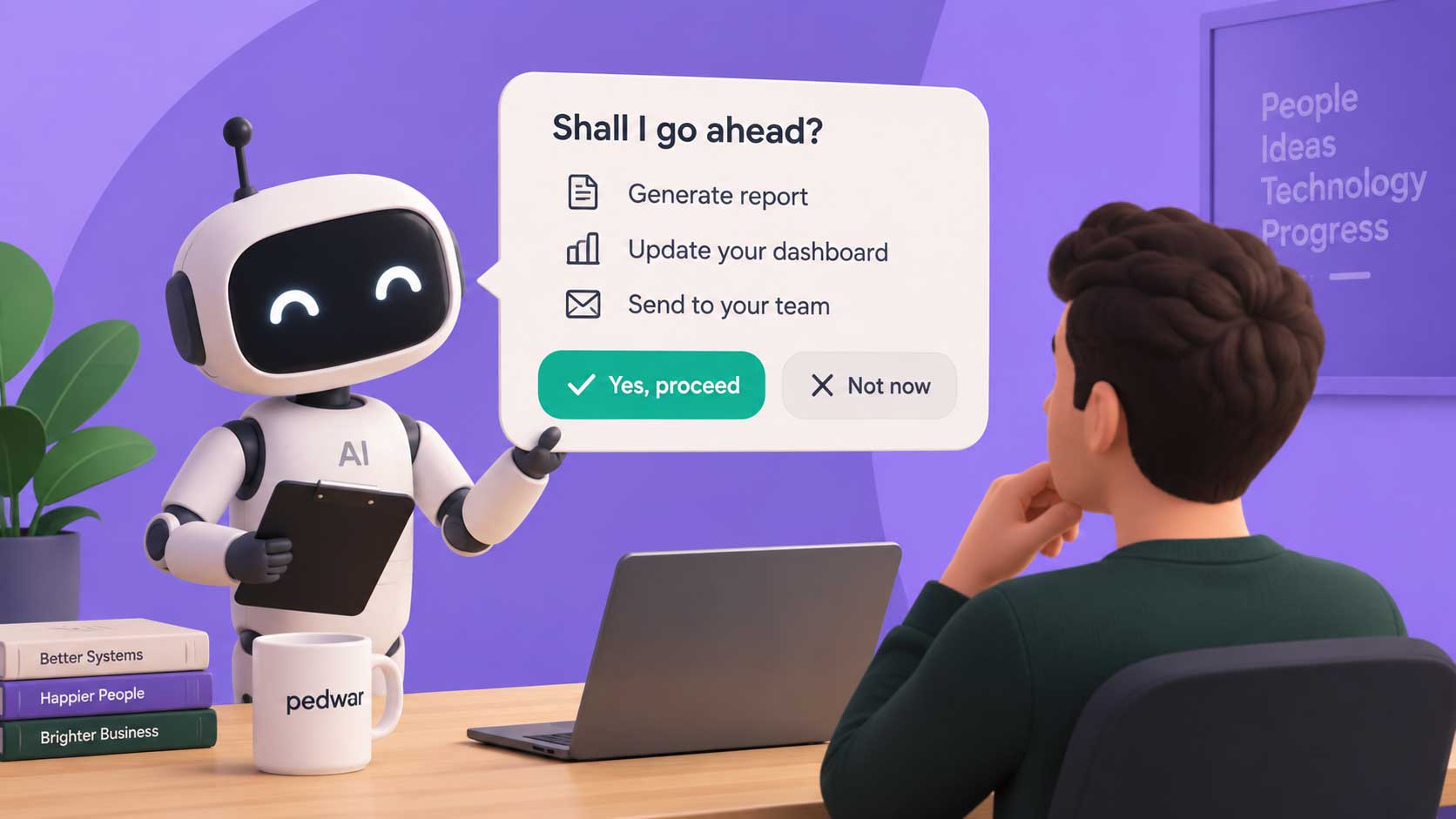
The most useful business AI works the other way round. The machine prepares the work. A person you trust signs it off. Nothing that matters happens without a human in the loop. It's less cinematic than the robot-takeover version, and it's the difference between AI that helps your business and AI that generates apologies.
Plenty of tasks don't need intelligence, artificial or otherwise. If the rule fits on a postcard, ordinary automation is cheaper, faster and easier to trust. AI earns its place on the fuzzy work: reading, interpreting, drafting, spotting. We've written about choosing between the two, and it's the first question worth asking, not the last.
The pattern that works is AI as a tireless junior colleague. Triaging documents and email so the urgent surfaces first. Drafting responses for a person to edit and send. Summarising a long case history before a call. Matching and categorising records. Flagging the anomaly a human should look at. In every case the AI does the reading and the suggesting; a person does the deciding.
Here's where these projects succeed or quietly fail. A review step must be a real decision, made by someone with the knowledge and the authority to say no, with enough context in front of them to judge. If the reviewer is rubber-stamping forty items an hour, you don't have human-in-the-loop. You have human-in-the-way, and the loop will fail politely and invisibly.
Confidence scores help with routing (send the messy ones to a person, wave the clear ones through) but confidence is a measure of the machine's certainty, not its correctness. It gets a vote, not a veto.
Who reviewed it, what changed, what got sent: an audit trail turns "the AI did something odd" from an argument into a lookup. It's also what accountability looks like when a customer, an auditor or a future you asks what happened. And plan for the boring failures too: the AI service will have a bad day eventually, and the workflow needs a manual path that doesn't grind your operation to a halt.
The number that matters isn't how clever the model is. It's whether the whole job got faster, more accurate or more consistent, including the review time. Measure before and after, and let the results decide how much control to keep. High-stakes and customer-facing work keeps tight review. Low-stakes internal drudgery can loosen over time, with evidence.
Start with the workflow, not the model. That's the whole philosophy of our AI integration work: find the drudgery, keep the judgement human, wire it into systems you already trust, and keep receipts. AI with a supervisor is just good staff work at machine speed.



We're proud to have been recognised as Wales' Most Trusted Web Design & Development Company for 2025. This award reflects our commitment to delivering exceptional digital solutions and outstanding client service that sets the standard for excellence.